John Bock / Anton Kern Gallery, New York
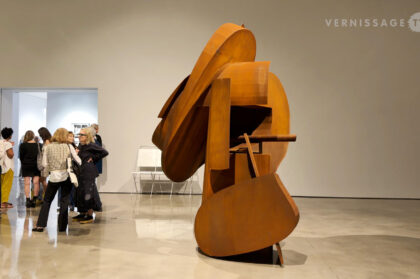
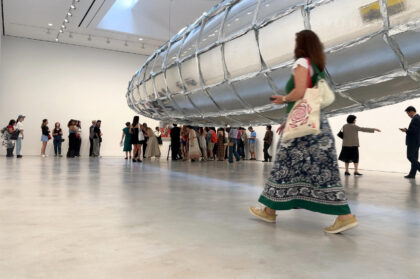
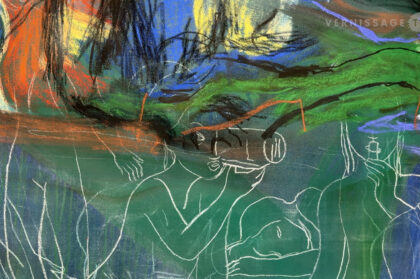
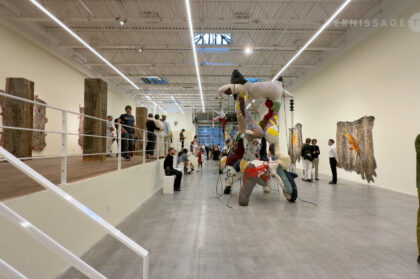
John Bock’s current exhibition at Anton Kern Gallery in New York is the German artist’s fifth solo show at the gallery. The exhibition features a two-channel video projection, “PARA – SCHIZO, ensnarled”, a group of hanging soft sculptures, “Büchse” (tin can), a metal sculpture reminiscent of a submarine, and a lecture-dance-performance on the opening night (March 1, 2010).
John Bock’s work has been exhibited widely including solo shows at Arko Art Center, Seoul; REDCAT, Los Angeles; Schirn Kunsthalle Frankfurt; and the Museum of Modern Art, New York. He also participated in the Biennale di Venezia, the Lyon Biennial, Documenta 11, and the Yokohama Triennale. A large sculpture-video installation by John Bock is currently on display at the New Museum in New York, in the Jeff Koons-curated group show “Skin Fruit” – Selections from the Dakis Joannou Collection.
John Bock at Anton Kern Gallery, New York, Opening Reception and Lecture, March 1, 2010.
PS: Full-length version of the performance available on our HD page.
PPS: See also John Bock: The Greased Bendsteering… – Lecture / Fashion Show at HKW Berlin on VernissageTV.
> Right-click (Mac: ctrl-click) this link to download Quicktime video file.
> Click this link to watch Quicktime video in new movie window.
March 19, 2010 | Entry filed under: New York, VernissageTV, art, no comment | 0
Tags: John Bock
Joseph Beuys: Make the Secrets Productive / PaceWildenstein, New York
During his lifetime he was controversial, but now the German performance and installation artist, sculptor, graphic artist, art theorist, pedagogue of art and politician Joseph Beuys is regarded as one of the most influential artists of the 20th century. His words “Every man is an artist” are cited again and again, not only by art art lovers.
Currently, PaceWildenstein in New York presents “Joseph Beuys: Make the Secrets Productive”, an exhibition of twelve sculptures, dating from the 1950s through the end of his career. Over 90 black and white photographs taken by Ute Klophaus, documenting eleven of the artist’s “Aktion” works, will be shown alongside four of these iconic happenings on film. The installation will also feature a separate screening room showcasing rare footage and interviews with Joseph Beuys.
In this video we have a look at this extraordinary exhibition and PaceWildenstein President Marc Glimcher and Director Birte Kleemann tell us how this show came about.
Among the works are Jeder Mensch ist ein Künstler (Make the Secrets Productive), a 1977 text-based sculpture painted on wood paneling with Braunkreuz, an earthy-looking substance Beuys created by combining household paint and hare’s blood. This important work of art indoctrinates each visitor with the Beuysian ideology that “every man is an artist” and its message is the anchor for the larger exhibition, which features a number of unique sculptures that have never before been presented in the United States. Among the sculptures are Feldbett (1982), OFEN (1983-85), Tisch mit Aggregat, Tisch 2 Pole, and Doppelaggregat. For more information visit PaceWildenstein’s website.
Joseph Beuys: Make the Secrets Productive at PaceWildenstein, 25th Street, New York, runs until April 10, 2010. A catalogue with essays by Heiner Bastian, Prof. Dr. Joachim Pissarro, Bershad Professor of Art History and Director of the Hunter College Galleries, and Prof. Dr. Eugen Blume, head of the Hamburg Bahnhof, Museum for Contemporary Art, Berlin, will accompany the exhibition. Currently, the Museum of Modern Art, New York, has dedicated one of its fourth floor galleries to an ongoing exhibition dedicated to Joseph Beuys. The focus of this installation centers on the museum’s recent acquisition of five vitrines created by the artist, with works dating from 1942 and 1982.
Joseph Beuys: Make the Secrets Productive / PaceWildenstein, New York. Private View, March 4, 2010.
PS: See also VernissageTV’s coverage of the exhibition mentioned in this segment, Joseph Beuys. We are the Revolution / Hamburger Bahnhof – Museum für Gegenwart, Berlin. Other Beuys related videos.
> Right-click (Mac: ctrl-click) this link to download Quicktime video file.
> Click this link to watch Quicktime video in new movie window.
Related Articles:
- Joseph Beuys and His Students at Sakıp Sabancı Museum Istanbul
- Beuys. We are the Revolution / Hamburger Bahnhof - Museum für Gegenwart, Berlin
March 18, 2010 | Entry filed under: New York, VernissageTV, art, interview | 0
Tags: Joseph Beuys
Beat Takeshi Kitano: Gosse de Peintre / Fondation Cartier, Paris
Currently, the Fondation Cartier is presenting the world of author, actor, comedian, TV show host, entertainer and artist Beat Takeshi Kitano 北野 武. Gosse de peintre is a site-specific exhibition for the Fondation Cartier pour l’art contemporain that presents a world in which the magical memories of Beat Takeshi Kitano’s childhood take center stage. “Kitano leads the visitor through surprises, gags, and games, all the while mocking contemporary art, experimenting with the sciences, and toying with the clichés associated with his country. Presenting paintings and video films, as well as astonishing objects and settings, whimsical and fantastic machines, Beat Takeshi Kitano invites the visitor to think, play, dream and join the show.” (excerpt from the PR).
Beat Takeshi Kitano: Gosse de Peintre at Fondation Cartier, Paris. March 9, 2010. Video by Christophe Ecoffet.
Beat Takeshi Kitano: Links | Videos | Images | More Images
> Right-click (Mac: ctrl-click) this link to download Quicktime video file.
> Click this link to watch Quicktime video in new movie window.
March 17, 2010 | Entry filed under: Paris, VernissageTV, art, interview | 0
Tags: 北野 武, Beat Takeshi Kitano
Strike a Pose – Video Screening at Art Dubai 2010. Interview with the Curators Sohrab Mohebbi and Özge Ersoy
Bidoun Projects has invited Sohrab Mohebbi and Özge Ersoy, independent curators based in New York, to curate a video screening for Art Dubai 2010. The screening is part of a survey of video representations of contemporary art in forms of documentations, mediation, educational, and promotional material to investigate the possibilities of the new media outlets. The screening, titled “Strike a Pose” offers a look on how progressive institutions have utilized the new media potentials, made available via the rapid expansion of the internet, in forms of podcasts, streamings, YouTube video channels and official video channels, to expand outreach and viewership.
The project tries to answer the questions: How is the regime of the visual changing with new PR strategies? How can art professionals/institutions experiment with presentation, documentation and promotion of art production and art events? Can they contribute to the formation of a new lexicon that can use mass media in engaging modes and establish a critical distance at the same time?
Part of the screening will be two of VernissageTV’s videos, Rudolf Stingel at Neue Nationalgalerie in Berlin and VTV’s report on the 11th International Istanbul Biennial 2009.
VernissageTV met with Sohrab and Özge in New York to talk about the project.
> Right-click (Mac: ctrl-click) this link to download Quicktime video file.
> Click this link to watch Quicktime video in new movie window.
March 16, 2010 | Entry filed under: New York, VernissageTV, art, interview | 0
The Danner Rotunda – Jewelry Arts in the Pinakothek der Moderne in Munich curated by Karl Fritsch
The Danner-Rotunda at Die Neue Sammlung – The International Design Museum Munich presents contemporary works from over hundred international goldsmiths. The exhibition is to a large extend drawn from the international collection of the Danner Foundation (Danner-Stiftung). The collection reflects the broad creative spectrum of modern jewelry arts, starting with the avant-garde artists of the 60’s and their immediate successors up to the experiment-focussed jewelry visions of the present day. They stem from European countries including Italy, the Netherlands, Great Britain, Sweden, Denmark, Norway and Spain, as well as from the USA, Australia, Japan and New Zealand. Other exhibits come from the collection of Die Neue Sammlung and private loans.
In rotation of several of several years, guest curators are invited to present a different view on the Danner Collection. The inaugural exhibition has been curated by Professor Hermann Jünger, who was Director of Studies for Gold Work at Munich’s Academy of Fine Arts from 1971 to 1990, and Professor Otto Künzli, who took over his task starting 1991.
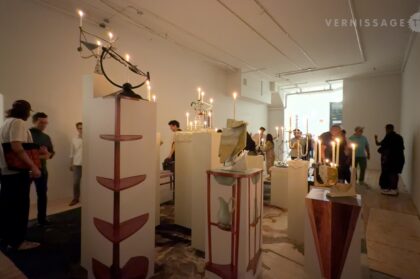
The current exhibition has been curated by Karl Fritsch, a renowned protagonist of the international jewelry scene. The Danner Collection is the core of the new exhibition. By expanding it with pieces from the loan of the gallery Spektrum, the donation of Peter Skubic, and donations and loans by individual jewelry artists, Karl Fritsch provides the visitor with a fresh and exceptional insight into the international jewelry art scene.
Danner Rotunda. New. Curated by Karl Fritsch. Curator Karl Fritsch in Conversation with Dr. Corinna Rösner (Chief Curator Die Neue Sammlung). Die Neue Sammlung – The International Design Museum Munich, March 5, 2010.
> Right-click (Mac: ctrl-click) this link to download Quicktime video file.
> Click this link to watch Quicktime video in new movie window.
Related Articles:
March 15, 2010 | Entry filed under: Munich, VernissageTV, design, interview | 0
Giampaolo Babetto: L’Italianita dei Gioielli / Die Neue Sammlung – The International Design Museum Munich
For his solo show “L’Italianita dei Gioielli” at Die Neue Sammlung – The International Design Museum Munich italian jewelry artist Giampaolo Babetto created an exhibition tailor-made to the circular, light-filled gallery space on the second floor of the rotunda in the Pinakothek der Moderne. In this video we have a look at the exhibition and Dr. Corinna Rösner, Chief Curator of Die Neue Sammlung provides us with an introduction to Giampaolo Babetto’s work.
Giampaolo Babetto (born 1947 in Padua) has had a marked influence on the avant-garde goldsmiths’ scene since the late 1960s. He is one of the protagonists of the so-called Padua School and has significantly moulded the image of art jewellery in Italy. Babetto’s works are decidedly contemporary, distinct and radical with regard to their formal reduction – and deeply rooted in Italian culture. Babetto’s work reflects contemporary art movements such as concrete art, minimal art, kinetic or op art in a unique, purist and plastic manner. Made up of different abstract elements, broken down into modular units, or rendered moveable through the use of ingenious links, Babetto’s works have a tectonic character – like mini architectural pieces or mini sculptures.
The artist prefers working in gold due to its stable malleability and its warm sheen which he combines with unconventional materials such as plastic or glass, dusting the surface with a velvet-like pigment in luminous reds or blues or using enamel and age-old niello-based techniques.
“Babetto’s works mirror a refined aesthetic concept based on dialogue, interrelationships and a blurring of boundaries between art genres.” (Florian Hufnagl, Director of Die Neue Sammlung).
A publication with texts by Dorothea Baumer and Ellen Maurer together with photographs by Ulrike Myrzik and Manfred Jarisch accompagnies the exhibition. An exhibition of Die Neue Sammlung – The International Design Museum Munich In co-operation with Istituto Italiano di Cultura, Munich.
Giampaolo Babetto: L’Italianita dei Gioielli / Die Neue Sammlung – The International Design Museum Munich. March 5, 2010.
Giampaolo Babetto in conversation with Dr. Corinna Rösner (in German language): Click here.
> Right-click (Mac: ctrl-click) this link to download Quicktime video file.
> Click this link to watch Quicktime video in new movie window.
Related Articles:
March 15, 2010 | Entry filed under: Munich, VernissageTV, design, interview | 0
Tags: Giampaolo Babetto
Aki Sasamoto: Strange Attractors / Performance / Whitney Biennial 2010
This video shows an excerpt of the performance Strange Attractors by Aki Sasamoto at the Whitney Museum of American Art on the 26th February 2010. Aki Sasamoto’s contribution to the Whitney Biennial 2010 consists of the “careful arrangement of sculpturally altered found objects and insistent repetitions of performance that change and add to the feelings of the installation; the objects themselves provide guidance for the artist’ structured improvisation. Sasamoto demonstrates and develops a kaleidoscopic worldview out of deeply personal episodes and a hypothetical mapping of the universe. In an attempt to understand and feel the mathematical concept of strange attractors in dynamical systems, she jumbles her recent obsession for doughnuts, fortune-tellers, hemorrhoids, and things detected in the world”. (Excerpt from the press release).
A full-length version is available on our HD page.
Aki Sasamoto is a New York-based, Japanese artist, who works in performance, sculpture, dance, and other media. Sasamoto completed an MFA degree in visual arts at Columbia University, and is a recipient of Visual Art Grant from Rema Hort Mann Foundation, the Toby Fund Award from the Toby Fund, and many US and Japanese scholarships. She has worked with lower lights collective, Jeffrey Schiff, Eiko & Koma, Koosil-ja Hwang, Hari Krishnan, and Yvonne Meier.
In her own work, Sasamoto is interested in everyday gestures on nothing and everything. Today’s performance/installation builds on and shifts out of yesterday’s, remembering, modifying, developing. Her works are shown both in dance and visual arts venues in New York, San Francisco, Germany, New Zealand, and Japan.
Aki Sasamoto: Strange Attractors, Whitney Biennial 2010. Performance (Excerpt), February 26, 2010, Whitney Museum of American Art, New York.
> Right-click (Mac: ctrl-click) this link to download Quicktime video file.
> Click this link to watch Quicktime video in new movie window.
March 12, 2010 | Entry filed under: New York, VernissageTV, art, no comment | 0
Tags: Aki Sasamoto
Sofi Zezmer: Remote Control / Mike Weiss Gallery, New York
Until April 3, 2010, Mike Weiss Gallery in New York presents Remote Control, a multimedia installation including sculpture, photography and drawing by artist Sofi Zezmer. It’s the artist’s third solo exhibition at Mike Weiss Gallery. Work her work, she uses fragments of manmade, mostly synthetic materials.
Sofi Zezmer constructs her works by a gradual additive process dependent on intuitive responses to the materials and objects she uses forming color-saturated assemblages. Among the elements she incorporates are objects such as drinking straws, IV drip tubing, construction netting, film, foil, packing materials, bicycle helmets, cable ties and funnels. “In fusing the elements and breaking them down, Zezmer disrupts the common meaning assigned to the items and calls into question our own familiarity with them. Zezmer’s sculptures suggest irrational Duchampian hybrids of mechanical and biological systems. They are embodiments of the complexity of life in the modern age, ruminations on the omnipresence of mass-production, space travel and biotechnology.” (Excerpt from the press release).
Sofi Zezmer lives and works in Germany. Her work has been exhibited in numerous international gallery and museum exhibitions, such as her solo exhibitions at Museum Wiesbaden, at the 21st Century Museum of Contemporary Art, Kanazawa, Japan and her forty two foot long hanging sculpture, Es Darf Kein Mangel Herrschen, commissioned by the NASPA Bank, Wiesbaden, Germany.
Sofi Zezmer: Remote Control / Mike Weiss Gallery, New York. Opening reception, February 27, 2010.
> Right-click (Mac: ctrl-click) this link to download Quicktime video file.
> Click this link to watch Quicktime video in new movie window.
March 11, 2010 | Entry filed under: New York, VernissageTV, art, no comment | 0
Tags: Sofi Zezmeer
Claes Oldenburg & Coosje van Bruggen: The European Desktop / Ivorypress Art + Books, Madrid
Ivorypress Art + Books and PaceWildenstein currently present an exhibition that represents a decision by Claes Oldenburg to re-explore a work that he and his wife Coosje van Bruggen had made together in 1990. The show The European Desktop is comprised of a number of sculptures – a shattered desk pad, a quill, an ink pot, a blotter, and postal scales. The European Desktop is the third and final work in a series of theatrical installations that grew out of Claes Oldenburg and Coosje van Bruggen’s performance with architect Frank Gehry for the 1995 Venice Biennale, Il Corso del Coltello (The Course of the Knife). The first two works in this series were The Haunted House and From the Entropic Library.
Claes Oldenburg & Coosje van Bruggen: The European Desktop / Ivorypress Art + Books, Madrid / Spain. Press Preview, February 16, 2010.
This segment has been realized with the kind support of Turespaña.
> Right-click (Mac: ctrl-click) this link to download Quicktime video file.
> Click this link to watch Quicktime video in new movie window.
March 10, 2010 | Entry filed under: Madrid, VernissageTV, art, no comment | 0
Tags: Claes Oldenburg, Claes Oldenburg & Coosje van Bruggen
Brian Belott: The Joy of File / Zürcher Studio, New York
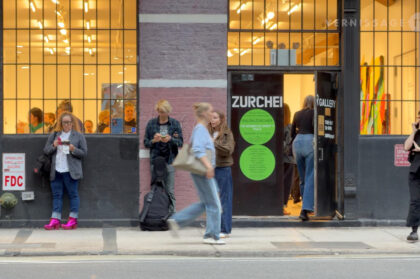
Zurcher Studio New York presents Bbbrrriiiaaannn Bbbeeellloootttttt: The Joy of File. The centerpiece of Brian Belott’s solo show at the gallery is a huge installation containing images of all sorts: pictures cut out of children’s books and old science textbooks, found photos and paper painted by Brian Belott himself. Part of the installation are also sound (talking, music and ambient noises collected from found cassette tapes and records and some sampled off of YouTube), glass paintings and mixed media books.
Brian Belott: The Joy of File / Zürcher Studio, New York. Opening reception, February 26, 2010.
> Right-click (Mac: ctrl-click) this link to download Quicktime video file.
> Click this link to watch Quicktime video in new movie window.
March 9, 2010 | Entry filed under: New York, VernissageTV, art, no comment | 0
Tags: Brian Belott