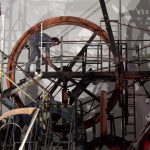
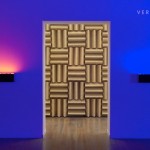
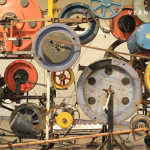
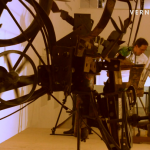
On 22 May 2025, the Swiss Artist Jean Tinguely (1925-1991) would have celebrated his 100th birthday. To mark this occasion, the artist is honoured internationally with a range of exhibitions and a multitude of events and activities. Jean Tinguely’s “Mengele-Totentanz” (Mengele Dance of Death) is a profound work from 1986 that stands as a cornerstone of the Swiss artist’s late career. This kinetic installation, housed at the Museum Tinguely in Basel, was born from the ashes of a devastating fire that struck a neighboring farmhouse in Neyruz, Switzerland, on August 26, 1986. Fascinated by the charred remnants, Tinguely salvaged materials like burnt wood, scrap iron, a hippopotamus skull, and parts of a mechanical maize press from the Mengele company, transforming them into 14 moving sculptures that evoke both the grotesque and the burlesque.
“Mengele-Totentanz” draws on the medieval Dance of Death (Totentanz) tradition, particularly Basel’s Prediger Church imagery, blending it with Tinguely’s personal reflections on mortality, shaped by his own near-death experience during heart surgery and the horrors of industrialized mass destruction, referenced through the Mengele name—a nod to the infamous Nazi doctor. The installation’s jerky movements, eerie sounds, and dramatic lighting create a macabre choreography, warning against totalitarianism while embracing the artist’s signature irony and Dadaist spirit. First exhibited in 1987 at the Church of San Samuele during Tinguely’s Venice retrospective, this work measures 300 x 440 x 420 cm and includes striking elements like lace fabric, black ribbons, and electric motors. “Mengele-Totentanz” is both a memento mori and a powerful commentary on humanity’s fragility and resilience.
Material/Technology: Scrap iron, harvesting machines from Mengele (Augsburg), hippopotamus skulls, electric motors.
Jean Tinguely: Mengele – Totentanz / Museum Tinguely. Basel (Switzerland), November 6, 2012.
— Right-click (Mac: ctrl-click) this link to download Quicktime video file.