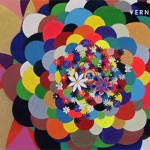
The exhibition Beatriz Milhazes: Rigor and Beauty at the Guggenheim Museum in New York showcases the vibrant, abstract work of Brazilian artist Beatriz Milhazes (b. 1960), spanning four decades from the 1980s to 2023. Featuring fifteen paintings and works on paper from the Guggenheim’s collection and key loans, the exhibition highlights her innovative “monotransfer” technique, where acrylic-painted motifs on plastic are layered onto canvas, creating dynamic compositions with organic patterns and geometric forms. Rooted in Brazilian heritage, Milhazes draws from Baroque colonial art, Carnival’s exuberance, Tropicália, and bossa nova, while engaging with global artists like Matisse and Mondrian. Early works like Santa Cruz (1995) reflect ornate influences, while later pieces like Mistura sagrada (2022) explore nature’s spiritual renewal post-COVID. Her collages (2013–2021) incorporate mass-produced materials and screenprints, showcasing bold experimentation. Part of the Guggenheim’s Collection in Focus series, this exhibition underscores Milhazes’s evolving artistry and cultural dialogue.
Beatriz Milhazes: Rigor and Beauty / Guggenheim Museum New York. August 30, 2025.
— Right-click (Mac: ctrl-click) this link to download Quicktime video file.
Exhibition text (excerpt):
This exhibition presents the work of global contemporary artist Beatriz Milhazes (b. 1960, Rio de Janeiro), who engages with her Brazilian cultural heritage and identity through the language of abstraction. The artist’s complex body of work spans four decades—from the 1980s to the present—and encompasses sculpture, collage, print, textiles, public art, and especially painting. This focused exhibition features a group of fifteen paintings and works on paper from 1995 to 2023, drawn from the museum’s permanent collection and augmented by key loans, which together contextualize the broader narrative of Milhazes’s artistic evolution.
Milhazes’s work is deeply rooted in Brazilian history and tradition, drawing from colonial art and architecture, decorative arts, and the vibrant celebration of Carnival—a week-long festival in Rio de Janeiro that showcases Brazilian culture through parades, music, performances, and elaborate costumes. She is also influenced by Tropicália, a 1960s cultural movement that blended art, music, and literature to celebrate Brazilian identity while protesting the repressive military regime. The rhythms and colors of bossa nova, a musical style born in Rio de Janeiro in the late 1950s, also echo throughout her work. Beyond these influences, Milhazes engages with the work of artists like Henri Matisse and Piet Mondrian, while also referencing Tarsila do Amaral, whose creations were fundamental to the visual and aesthetic development of Brazilian Modernism.
In 1989 Milhazes developed an innovative technique she calls “monotransfer,” inspired by the monotype printing process, in which a painted image is transferred from a plate to paper, producing a mirror image. She begins her process by painting motifs onto clear plastic sheets with acrylic paint. Once the acrylic dries, she layers and adheres the painted films to canvas and then peels away the plastic, revealing the forms in reverse. The resulting compositions are vibrant and dynamic, combining abstract forms, organic patterns, and geometric structures on textured surfaces imbued with the memory of the artist’s actions.
The early paintings in this exhibition, primarily from the museum’s collection—such as Santa Cruz (1995), In albis (1995–96), and As quatro estaçōes (The Four Seasons, 1997)—draw inspiration from the opulence of 18th-century Brazilian Baroque colonial churches and ornamental garments. Milhazes synthesizes these influences into abstract and representative motifs, with circles and arabesques, delicate crochet and lace, flowers and floral patterns, and ornate pearls and ironwork emerging throughout her compositions. By 2000, she began exploring optical effects in her paintings, using linear repetitions to create undulating patterns and visual rhythms, as seen in Paisagem carioca (Carioca Landscape, 2000), O cravo e a rosa (The Carnation and the Rose, 2000), and O Caipira (The Caipira, 2004).
The works on paper in this exhibition, created between 2013 and 2021, demonstrate Milhazes’s continued experimentation with collage. She combines mass-produced elements like branded shopping bags, chocolate bar wrappers, and patterned paper with cutouts from her own solid-colored screenprints to create intricate patterns and bold abstract configurations.
Milhazes’s recent paintings, including Mistura sagrada (Sacred Mixture, 2022), mark a shift toward exploring the spiritual power of nature in the wake of the COVID-19 pandemic. Although references to the natural world have been present since her early career, here she delves into cycles of renewal—life and death—through colorful, angular forms and intricate patterns. Organic elements, reflective of the artist’s proximity to Rio de Janeiro’s Botanical Garden, Tijuca Forest, and Copacabana Beach, are echoed in the harmonious geometries, conceptual systems, and chromatic universes that span her oeuvre.
Beatriz Milhazes: Rigor and Beauty is the second installment in the exhibition series Collection in Focus, which highlights the museum’s permanent collection. The series is part of a reinvigorated effort to make the Guggenheim New York’s world-renowned holdings more accessible to the public.