The Guggenheim Museum in New York currently shows a major solo exhibition of the artist Rashid Johnson. For nearly three decades, Chicago-born artist Rashid Johnson (b. 1977) has developed a multifaceted oeuvre, weaving together influences from history, philosophy, literature, and music. This significant solo exhibition underscores Johnson’s role as an art history scholar, a bridge to Black popular culture, and a dynamic figure in contemporary art. Nearly 90 pieces—ranging from black-soap paintings and spray-painted text works to expansive sculptures, films, and videos—occupy the museum’s rotunda, featuring Sanguine, a grand site-specific installation on the top ramp, incorporating a piano for live musical performances. The exhibition runs until January 20, 2026.
Rashid Johnson: A Poem for Deep Thinkers / Guggenheim Museum New York. New York, August 30, 2025.
— Right-click (Mac: ctrl-click) this link to download Quicktime video file.
Complete film on Vimeo:
Press text (excerpt):
The Guggenheim New York presents a major solo exhibition of work by Rashid Johnson, opening April 18, 2025, and remaining on view through January 18, 2026. Encompassing the entirety of the museum’s rotunda, the show is Johnson’s first solo presentation at the Guggenheim, his largest exhibition to date, and the first expansive museum survey of his work in over a decade. Rashid Johnson: A Poem for Deep Thinkers brings together more than ninety artworks, including an outdoor sculpture and new pieces made specifically for the exhibition—two of which will be activated through ongoing performances.
The survey spans pivotal phases of Johnson’s career, including notable series such as The New Negro Escapist Social and Athletic Club, Cosmic Slops, black-soap shelf paintings, spray-painted text works, the more recent Anxious Men and Broken Men series, and large-scale indoor and outdoor sculptures. The exhibition offers a loose chronology of Johnson’s artistic evolution across nearly three decades, traversing cycles of social alienation, self-examination, and artistic freedom. Beginning with his early explorations in photography, video, and installations, and extending to his recent ventures into materially hybrid paintings and assemblages, Johnson brings nuance to exploring the human psyche amid the profound historical influences of our time, all while reflecting on themes of masculinity, parenthood, and care for self and others.
Explains Johnson, “This exhibition continues the conversation I’ve always been invested in: one that allows for freedom of expression and an awareness of artistic possibilities. I’ve always embraced the fluidity between mediums. For me, medium specificity has never been the goal—it’s about how the project can move freely between different forms, creating space for a broader conversation that goes beyond the limitations of any one medium.”
Exhibition Highlights
As visitors approach the museum, they are met by Johnson’s outdoor sculpture, Black Steel in the Hour of Chaos (2008), a large steel sculpture with graphic design–inspired trim lines and gun-scope references that brings forth Jasper Johns’s target works. Directly influenced by hip-hop pioneer Public Enemy, the piece invites the viewer to question who is in control. Inside the museum, the rotunda floor features Untitled (2025), a new mosaic work made especially for the Guggenheim exhibition, along with Rotunda Stage (2025), an interactive space for performances. As visitors proceed up the first ramp, they are greeted by Johnson’s photograph Self-Portrait Laying on Jack Johnson’s Grave (2006), an early work that explores cultural lineages, connecting the artist’s last name and Chicago roots (where the grave site is located) with the first Black heavyweight boxer whose victory over a white fighter in 1910 triggered race riots.
The Guggenheim’s High Gallery features a miniature survey of Johnson’s career, showing a range of early and recent pieces, including sculptures, paintings, a mosaic, and a spray-painted text work.
On Rotunda Levels 1 and 2, visitors have the opportunity to learn about Johnson’s emergence on the art scene, beginning with a series of photographs he took in his early twenties that helped launch his career when he became the youngest artist featured in Thelma Golden’s seminal 2001 exhibition Freestyle at the Studio Museum in Harlem. Viewers also encounter Johnson’s early work in sculpture, installation, text, and video, which remains an abiding medium for the artist.
Progressing through the exhibition, museumgoers will discover more of Johnson’s mixed media pieces. Rotunda Levels 3 and 4 continue an exploration of video works including Black Yoga (2010) and The New Black Yoga (2011). This segment also introduces Johnson’s breakthrough Cosmic Slop painting series (2008), made of black soap and wax, underscoring Johnson’s investment in materials as cultural signifiers.
Rotunda Level 5 showcases Johnson’s sculptures, such as his Untitled Bust series composed of heavily worked glazed stoneware. This ramp also contains mosaics and collages, as well as later paintings such as Anxious Red Painting “August 18th” (2020).
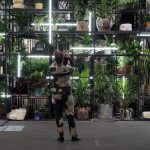
At the top of the museum, Rotunda Level 6 features the monumental installation Sanguine, a large, gridded steel structure consisting of plants, books, and a piano that supports a series of cascading plants that seem to float in mid-air. In dialogue with the performance and public-engagement program, Sanguine’s piano will be activated every Friday and Sunday. Toward the end of this ramp is a monitor presenting Johnson’s most recent films, including a 2024 film also called Sanguine, which focus on relationship with the maternal and paternal sides of his family. Closing the exhibition is a never-before-seen 2025 painting hung in a contemplative area where viewers are encouraged to engage with the art in self-directed reflection.
Organization
The exhibition is cocurated by Naomi Beckwith, Deputy Director and Jennifer and David Stockman Chief Curator of the Solomon R. Guggenheim Museum and Foundation, New York, and Andrea Karnes, Interim Director and Chief Curator of the Modern Art Museum of Fort Worth, Texas, with additional support from Faith Hunter, Curatorial Assistant, Guggenheim New York.
Says Beckwith, “The Guggenheim could not be more thrilled to host this timely exhibition. Rashid Johnson is a master at synthesizing the key tendencies of twenty-first century art: the ability to move freely between different modes—painting, video, sculpture, performance—each a refined tool for forging a relationship between his own life history and art history. Above all, Johnson well understands that the vocation of the artist entails more than looking inwardly, it is also an opportunity to create, quite literally, platforms for the creative expression and self-care of others.”
The exhibition’s title, A Poem for Deep Thinkers, takes its name from a poem by Amiri Baraka, an American poet, writer, teacher, and political activist whose work is a frequent source of inspiration for Johnson.