On display until February 7, 2026, Nina Johnson presents three new exhibitions in her gallery in Miami: Two solo exhibitions, Dara Friedman and Emmett Moore, and a group show, Acid Bath House, curated by Jarrett Earnest. In this video, we have a look at the exhibitions on the occasion of the opening reception on December 1, 2025.
Acid Bath House, curated by Jarrett Earnest, Nina Johnson Front Gallery
Curated by Jarrett Earnest, Acid Bath House is a group exhibition exploring queer experience, psychedelic perception, and the intersections of desire, anonymity, and liberation. Inspired by the curator’s own bathhouse encounter under the influence of LSD, the show considers pleasure, transience, and the dissolution of fixed identity. Participating artists include Steven Arnold, Genesis Breyer P-Orridge, Juliana Huxtable, TM Davy, Dean Sameshima, and others. Works range from explicit to abstract, embracing beauty, sensuality, and resistance in varied materials and forms, proposing queer life as an ongoing psychedelic erotica essential for collective survival.
Dara Friedman: Star People, Nina Johnson Upstairs Gallery
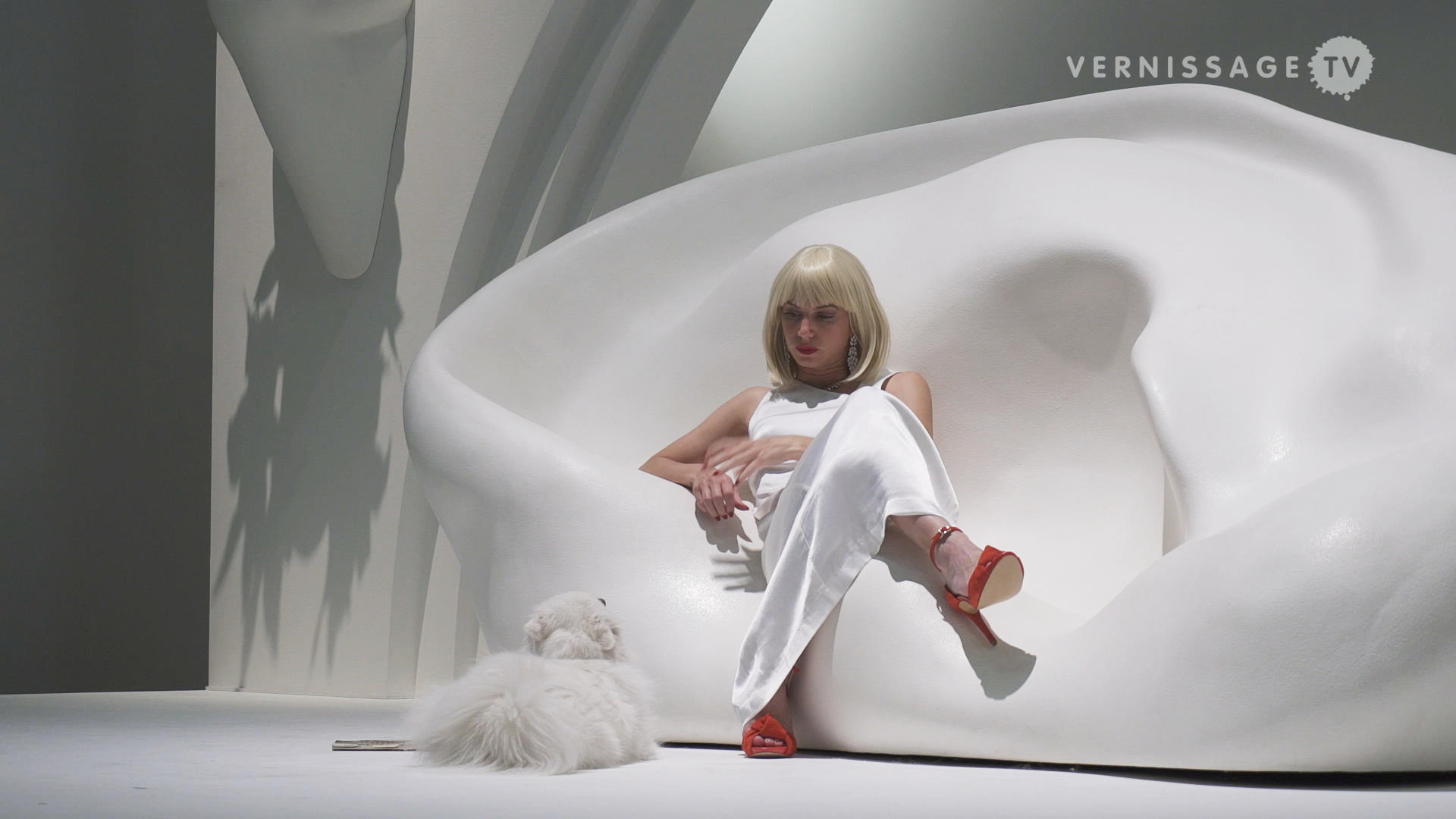
In Star People, Miami- and New York-based artist and filmmaker Dara Friedman presents over a dozen new mirrored and felt-covered sculptural figures that explore light, shadow, reflection, and cosmic connection. Towering silhouettes hold brass gongs or absorb light entirely, while installations such as Alligator Eyes (Hill) invite reclining viewers. Accompanied by the film Gong Camp, the works evoke the Pleiades, bodily experience, and the integration of personal and cosmological realms. Friedman reduces materials to essential properties, generating both serene and intense emotional resonance through reflections, vibrations, and the interplay of presence and absence.
Emmett Moore: Neon Sun, Nina Johnson Sculpture Garden
Miami-based artist and designer Emmett Moore presents Neon Sun, a solo exhibition of new functional outdoor sculptures arranged as a domestic garden. Works include aluminum seating, tables, and lighting made from repurposed industrial materials—I-beams, grating, and cast impressions of tree trunks and mussel shells—painted vivid neon pink. Oversized lamps carved from scrap EPS foam mimic coral rock formations while hanging from trees. The pieces blend utility and sculpture, addressing Miami’s vernacular architecture, ecological fragility, and cycles of waste and reuse. Select works will also appear at Art Basel Miami Beach 2025.
Acid Bath House, Dara Friedman, and Emmett Moore at Nina Johnson Gallery, Miami. Miami (USA), December 1, 2025.
— Right-click (Mac: ctrl-click) this link to download Quicktime video file.
Exhibition texts (excerpt):
Acid Bath House, curated by Jarrett Earnest
December 1st, 2025 – February 7th, 2026
Nina Johnson is proud to present Acid Bath House, a group exhibition curated by Jarrett Earnest.
“Men awkwardly crowd around a waiting room, entering one by one into the even smaller room where you can pay the entry. The tab of acid I’d taken must have already begun to hit because the guy looked me over and asked, Do you know where you are? So simple as to seem like some kind of trick question. Does he mean, like, in this material realm? Or, that I’m in Washington DC? I hesitated too long and then tried, A bathhouse. —Works for me, and he hands me a towel and key to a locker.
Even by bathhouse standards this one is kind of gross, and I feel incredibly aware of its grossness—that pervasive mildewy-sweaty smell, a carpeted (!) lounge with pleather furniture and giant TVs playing gay porn, a rabbit’s warren of small rooms, empty save narrow wipeable “beds”—but I’m also feeling wave upon wave of bodily euphoria that transforms my experience with a sensuous glamour.
Sitting in the dry sauna the solemn dudes gradually peel out because of my giggling. Wow I must be annoying, and try a bit harder to keep it together. But the air feels so good! I enter an exhibitionist’s dream: a string of shower heads lining one side of an open space. When hot water starts pouring over me its as though I’m dissolving into water and air, like an ice cube dancing in a skillet. I am in a fucking Herbal Essences commercial!
Mostly everyone is grim and serious, high on the toxic combination of masculinity and anonymity—which inevitably generates scary effects. Touring the dim steam room, the dark corridors with weird reddish mood lighting, makes the whole place feel laced with promise and threat like an erotic bardo—the suspended interval between death and rebirth, in which all the trappings of the material world and the certainty of a ‘self’ are lost in the process of transformation
The Tibetan Book of the Dead describes the passage of a soul through an amorphous atemporal landscape, with all manner of inexplicable atmospheric outbursts, alternately terrifying and seductive, meant to distract, detour, detain. It advises remembering that ‘you have no physical body of flesh and blood, so whatever sounds, colors and rays of light occur, they cannot hurt you and you cannot die. It is enough simply to recognize them as your projections.’ This floating attitude is highly advisable when acid is peaking, and also for life in general—which is the real point, that all is transient all the time.
Looking at everyone there, so temporarily on this planet, in this goofy place all trying to get off, fills me with tenderness, with the literal nakedness of desire and our various attempts to connect. Pleasure. If extended beyond a body, does ‘queerness’ still exist? Is it a force? Does it push toward liberation, toward fluidity and change, or is it too easily mired in defining architectures of privilege to get out of its own way? Can we separate queerness from ‘identity’ as it currently functions? And, if so, should we?
In my experience, in places where queer people come together—a sex club, dance floor, an art gallery, a camp out, —and in the things queer people make with and for each other, there is a specific energy that everyone needs if we are to survive on this planet together. The possibility of queer life is psychedelic erotica.
Whatever that might be, its appearance will necessarily take many forms, and it must take even more and newer forms as the darkness consolidates around us, as conformity becomes legally coerced and brutally enforced. This might be explicit, it might be abstract, it might be rainbow-colored or mirrored or glittering or velvety or forged in chainmail or rescued from the trash—as long as it is beautiful, pleasurable, and free.” – Jarrett Earnest
Participating artists include Steven Arnold, Belasco, Sean Bennett, Anna Betbeze, Genesis Breyer P-Orridge, Jake Brush, Matt Connors, Gaby Collins-Fernandez, TM Davy, Johnnie Gardner, Jesse Genepi, Sadao Hasegawa, Juliana Huxtable, Savannah Knoop, Keith Lafuente, Moses Leonardo, Chris Martin, Reuben Paterson, Yuval Pudik, Lee Relvas, Dean Sameshima, Laurel Sparks, Paula Gately Tillman, Chris Udemezue, Nicole Wittenberg, and Carrie Yamaoka.
Acid Bath House will be on view in the Front Gallery at Nina Johnson through February 14, 2026.
Dara Friedman: Star People
December 1st, 2025 – February 7th, 2026
Nina Johnson is pleased to present Star People, a solo exhibition by Dara Friedman, a visual artist, creator of environmental earthworks, and filmmaker who engages with everyday sights and sounds as raw material for works that reverberate with emotional intensity. With a background in structural film and dance, her works call for a radical reduction of mediums to their most essential properties, while remaining unabashedly sensual and emotive. Bearing rich imagery and a strong emphasis on bodily experience, with Star People, Friedman expands her filmmaking practice of working with light and sound to a sequence of tangible sculptural forms.
The exhibition includes more than a dozen new works conceived specifically for this presentation. In Star People, a series of gracefully towering, mirrored shadow figures reflect light and the gaze. Some dangle sun-like brass gongs from their fingertips. The impossibility of a reflective shadow creates a sense of wonder. Others offer an opaque darkness, covered with black felt, the double entendre of the material intentional. Shadows and mirrors are both literally “flat” yet have endless depth. They are infinities. The liquid reflecting forms contain the condensed semiotics of light and vibration. Friedman invokes the Pleiades star cluster and its associations with kinship and passage between realms. In Golden Hand (Night Journey of the Sun), an elegant brass arm is visible, either emerging or disappearing from view. Alligator Eyes (Hill), a sculptural carpet installation shaped like a low hill or the eyes of an alligator peering above the water’s surface, invites viewers to recline and be supported. In the film Gong Camp, suns rise and set, overlapping and intermingling with the light seared edges of twirling cloth-draped figures, gongs reverberating throughout. The surrealist trope of humor darts throughout the exhibition.
I used to have a studio in the alleyway by Club Deuce on Miami Beach. In this studio there was a big metal door that I managed to unlock, and behind that was a vast moldering storage space with the ceiling caving in — like a secret behind a locked door. The metaphysical sense of something ‘being on the other side’ was a real estate reality. This discovery translated to the film Bim Bam (1999), a sort of revolving door that led to ‘the other side,’ another dimension, a place of light, but just briefly, although repeatedly, visited before returning. Dipping in a toe at the edge.
The silhouette, the light and the shadow of this earlier work is present in Star People. The echo of the slamming metal door morphed to a gentler, sustaining vibration: a dance, energetic and never-ending. Now these visitations have become less tentative, frequently traveled and investigated, both internally and cosmologically. It is no longer a place to visit, but what one is. The perceived metaphysical light beyond the body, is in fact of the body. In turn, the body is of Earth and therefore integrating within the larger cosmological order.
What is filmmaking? Let’s suppose the first film is the experience of watching the Sun set and the Moon rise on the stage that is the horizon line. This light-shadow-movement, a physical expression of emotion. The structural aspects (of film) are well suited to hold and support the intangibles: relationships of light, shadow, and feeling as it is received by the body.
If you are facing the Sun, your shadow is behind you. A constant companion when you walk in sunlight. When you turn to face your shadow, the back of your body is illuminated. The unseen, emanating forth in shining rays of black, can be felt.
Star People will be on view in the Upstairs Gallery at Nina Johnson through February 7, 2026.
Dara Friedman
Dara Friedman is a German-born artist and filmmaker working in Miami and New York. She uses everyday sights, sounds, and natural phenomena as the raw material for artworks that reverberate with emotional energy. With a background in structural film and dance, Friedman’s work calls for a radical reduction of form to its most essential properties. In place of linear storylines, her films and site-specific works typically portray straightforward actions and situations that unfold according to predetermined rules and guidelines. Yet for all of Friedman’s strenuous logic and discipline, her approach remains unabashedly sensual and emotive. Bearing rich imagery and a strong emphasis on bodily experience, her works generate moments of high-pitched, cathartic intensity as well as serene, even euphoric interludes.
Among her numerous solo shows are The Tiger’s Tail, San Carlo, Cremona, Italy (2022); Harburger Kunstverein (2019), a mid-career survey Dara Friedman: Perfect Stranger, Pérez Art Museum Miami (2017-2018), accompanied by a catalog raisonée published by Prestel, Aspen Art Museum (2017), Hammer Museum, Los Angeles (2014), Museum of Contemporary Art of Detroit (2014), Contemporary Art Museum of Raleigh, North California (2012), Public Art Fund New York (2007), and Gavin Brown’s Enterprise, New York (1998, 2000, 2002, 2007, 2011, 2014 and 2017), Galleria Massimo Minini, Brescia, Italy (2002), Supportico Lopez, Berlin (2017), Galleria Franco Noero, Turin, Italy (2018), Kayne Griffin Corcoran (2014, 2017). Screenings and discussions of an on-going storytelling project Sky Woman Women (2024) have taken place at Buffalo Albright Knox Museum of Art, The New School for Social Research, Vassar College, Syracuse University, and other universities.
In addition to her exhibitions, Friedman has realized a series of permanent Environmental Earthworks, including Schlangensonne, Lanz’scher Park, Düsseldorf, Germany (2025); The Tiger’s Tail, San Carlo, Cremona, Italy (2022); River Hill (Silo City, Buffalo, University at Buffalo Arts Collaboratory, 2022); and The Empress (Miami, 2020). Major public collections include The Museum of Modern Art, New York; Whitney Museum of American Art, New York; Hammer Museum, Los Angeles; Pérez Art Museum, Miami; French National Collection, and Julia Stoschek Collection, Düsseldorf. Friedman is a recipient of the Rome Prize (1999) and a Guggenheim Fellow (2019).
Emmett Moore: Neon Sun
December 1st, 2025 – February 7th, 2026
Nina Johnson is proud to present Neon Sun, a solo exhibition by Miami-based artist and designer Emmett Moore. Featuring new functional outdoor works—including seating, lighting, and vessels—arranged as though in a home garden, the exhibition responds to a distinctly local vernacular while reflecting on the interplay between the built and natural environments. For Moore, the show represents a culmination of many years of studio practice, bringing together long-standing techniques such as faux coral rock with new explorations like aluminum casting.
Drawing on his background in design and architecture, Moore works at the intersection of utility and sculpture, transforming industrial remnants and discarded materials into refined forms. Aluminum seating elements—chairs, benches, and tables—are composed of I-beams, grating, and cast impressions of tree trunks and mussel shells, then painted in vivid neon pink, a color Moore describes as “pure and primal—the color of flesh, flowers, and flamingos,” embodying a duality that is at once sensual and violent, beautiful and grotesque. Seductive and hyperreal, neon pink evokes the cheap glow of open signs and strip clubs while also appearing in natural phenomena and the very gases that make up our world. This negotiation between raw infrastructure and ecological fragility mirrors Miami itself: a city of constant construction layered atop a deep history of habitation and biodiversity.
Above the seating, lamps carved from Moore’s signature process of using scrap EPS foam resemble massive coral rock formations yet float improbably from the trees. These works reference Miami’s oolitic limestone bedrock—the geological foundation that made development possible—while underscoring cycles of reuse, illusion, and transformation. A 3D-printed bowl composed of interwoven mussel shells and disposable lighters extends this thread, drawing parallels between ancient Native shell mounds at the mouth of the Miami River and contemporary monuments of waste.
“I designed and built my own house in Miami and I make my own furniture. All my concepts for work are tested in my home,” Moore explains. That personal ethos of functionality grounds the exhibition: even as the works embody histories of consumption, cycles of accumulation, and tensions between artifice and authenticity, they remain usable as seating, tables, or lighting—anchoring sculpture in the everyday. Moore’s practice, rooted in Miami, merges design and fine art to address themes of material transformation, nature and ecology, and the unfinished infrastructures of the urban landscape. His works embody a careful balance of humor, rigor, and experimentation, transforming waste into form and functional objects into cultural vessels.
Neon Sun will be on view in the Sculpture Garden at Nina Johnson through February 14, 2026. Select works from this body of work will also be featured in the gallery’s booth at Art Basel Miami Beach 2025, serving as both sculptural artworks and the seating and tables for the presentation.
Emmett Moore
Emmett Moore is a Miami-based artist and designer whose interdisciplinary practice moves fluidly between art, design, and architecture. His work examines the shifting relationship between the built and natural environments, using functionality as both a structural premise and a conceptual provocation.
Working with the forms of everyday objects, Moore explores the universality and endurance of the utilitarian, reframing the familiar through shifts in material, color, and context. His material language often draws from secondhand goods, repurposed construction components, and found refuse, strategically employed to collapse traditional hierarchies between the refined and the commonplace. Within this framework, functional objects become vessels for broader cultural, and ecological narratives, ultimately transcending their intended purpose to occupy an elevated role.
His work has been shown institutionally at the RISD Museum, the Frost Art Museum, the Miami Art Museum, the Bass Museum of Art, and is in the permanent collection of the Perez Art Museum Miami. He was the first Miami-based designer to exhibit a solo exhibition at Design Miami. Moore’s work has been covered by Art in America, The Guardian, The Miami Herald, Cultured Magazine, Architectural Digest, Artsy and The Art Newspaper among others. Moore was named the Miami New Times’ Best Visual Artist in 2015 and 2021.