Taiwan presents “Screen Melancholy: Li Yi-Fan” as its Collateral Event at the 61st International Art Exhibition – La Biennale di Venezia. Organized by the Taipei Fine Arts Museum (TFAM), the exhibition runs from May 9 to November 22, 2026, at the historic Palazzo delle Prigioni in Venice. Artist Li Yi-Fan and curator Raphael Fonseca, both shaped by the rise of the internet, explore the melancholy induced by prolonged screen use and the anxieties of the digital age, including information overload and rapid AI development. The presentation features a new 60-minute video work centered on an “eyeball” returning home, accompanied by two smaller video pieces and large-scale 3D-printed sculptures of body parts that serve as both installation elements and seating. Drawing on Li’s practice of digital puppetry and real-time game engines, the immersive installation blurs boundaries between physical space, virtual imagery, and human perception. The project connects contemporary technological concerns with historical references such as Albrecht Dürer’s Melencolia I. Public programs and a new bilingual artist book will accompany the exhibition.
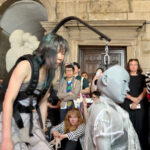
Taiwan in Venice 2026: Screen Melancholy: Li Yi-Fan . TFAM of Taiwan Collateral Event at the 61st International Art Exhibition – La Biennale di Venezia. Exhibition walkthrough, impressions from the opening, and interviews with the artist Li Yi-Fan and the curator Raphael Fonseca. Venice (Italy), May 7, 2026.
–– Right-click (Mac: ctrl-click) this link to download Quicktime video file.
Press release (excerpt):
Taiwan in Venice 2026: Screen Melancholy: Li Yi-Fan . TFAM of Taiwan Collateral Event at the 61st International Art Exhibition – La Biennale di Venezia.
New works debut to reflect on humanity’s contemporary relationship with technology
Screen Melancholy: Li Yi-Fan at the 61st International Art Exhibition – La Biennale di Venezia will be held at the Palazzo delle Prigioni from May 9 to November 22, 2026. During the opening week, from May 7 to May 9, a series of public programs will be held in the afternoons. The opening ceremony will take place on the evening of May 7. In a press conference today (March 31), artist Li Yi-Fan, together with the curator Raphael Fonseca and the Taipei Fine Arts Museum team, unveiled further details of the brand-new video artwork that will be presented.
In this year’s “TFAM of Taiwan Collateral Event,” the artist and curator, who both came of age when internet technology first exploded, serve as observers of the era of digital transformation, offering fresh perspectives and contemporary insights through narratives infused with humor and absurdity. Originally conceived in Portuguese, the title ‘Melancolia de tela’ refers to the state of melancholy induced by prolonged screen use. As it evolves across languages into English and Chinese, new nuances unfolded under different contexts. The state of ‘Melancholy’ addresses the anxiety stemming from information overload in the digital age and the rapid development of AI, reflecting the increasingly flattened sensory experiences and emotional states of individuals.
Fonseca traces the artist’s creative trajectory, from his first work, A Walk by the Sea (2011), to his new creation for this year’s Biennale Arte 2026, examining the evolution of his visual techniques and narrative rhythm, and how his scope of awareness has come to encompass contemporary digital culture. Simultaneously placing this under the lens of Western art history, Fonseca draws inspiration from German artist Albrecht Dürer’s 1514 work Melencolia I, bridging the Renaissance-era contemplation of the human condition and a present-day reflection on technological and visual anxieties.
TFAM director Li-Chen Loh notes, “For years, Taipei Fine Arts Museum has contributed to the cultural discourses of different periods through a range of exhibition strategies, showcasing the distinctiveness of Taiwanese art within the global context. This year, the curator is helping broaden the contextual framework of the artist Li Yi-Fan’s works with an outlook that transcends culture and geography. This enables the TFAM of Taiwan Collateral Event in Venice to keep breaking new ground in discourse and international exchange. The curator and artist are focusing on how we reinterpret the world and redefine our own place in it, as imagery becomes increasingly instantaneous and infinitely replicable.”
Born in Taipei, Li Yi-Fan is currently participating in an artist residency of the Rijksakademie van Beeldende Kunsten program in Amsterdam. Having long developed his own video production tools and refined a creative approach known as ‘digital puppetry’, Li began using utilized real-time game engines in 2021 as a means to make animation production a more intuitive process, transforming images into a form of private exploration and metacognition. Through his work, Li also reveals the power structures underlying imagery, re-examines the relationship between human and video technology, exploring how imagery shapes human perception. “Screen Melancholy” marks a pivotal new phase in the artist’s creative practice. Bringing together years of research in visual technology, it searches for the essence of humanity within the gaps in machine learning and generative AI, leading us to ponder our current state of expanding knowledge and technological anxiety.
Taipei Fine Arts Museum began hosting exhibitions at the Palazzo delle Prigioni since 1995. This building was built in the early 17th century as a prison connected to the Palazzo Ducale, and prisoners of the past were fated to walk between the two as they proceeded to the cells where they would spend the rest of their lives. Li engages with the historical and architectural context of the Palazzo delle Prigioni, creating an unprecedented work that integrates the physical space into its visual narrative. As viewers walk into this ‘container’ of images, sounds, and sculptures, they seem to awaken bodily memories as they engage with the work. Amid the interplay of the physical and the virtual, viewers are drawn into an intimate, immersive experience of at once “watching” and “being watched”.
Centered in the space is a 60-minute new video work, accompanied by 2 new videos on smaller screens. In the main video, Li tells a story of an ‘eyeball’ returning home, as a way to explore the layered relations between humans and images. Narrated like an instructional video in the tone of an improvisational soliloquy, the work reflects on explanations of computer animation and AIgenerated imagery, discussing the difference between ‘high’ and ‘low’ art. Through dialogues featuring the reunion of various ‘human organs’, he reflects on the impact of AI on humanity. As the video unfolds, the scenes shift, transforming the Palazzo delle Prigioni into a dramatically dynamic stage, where desire entwines with fear, exposing the close relationship millennials have with technology.
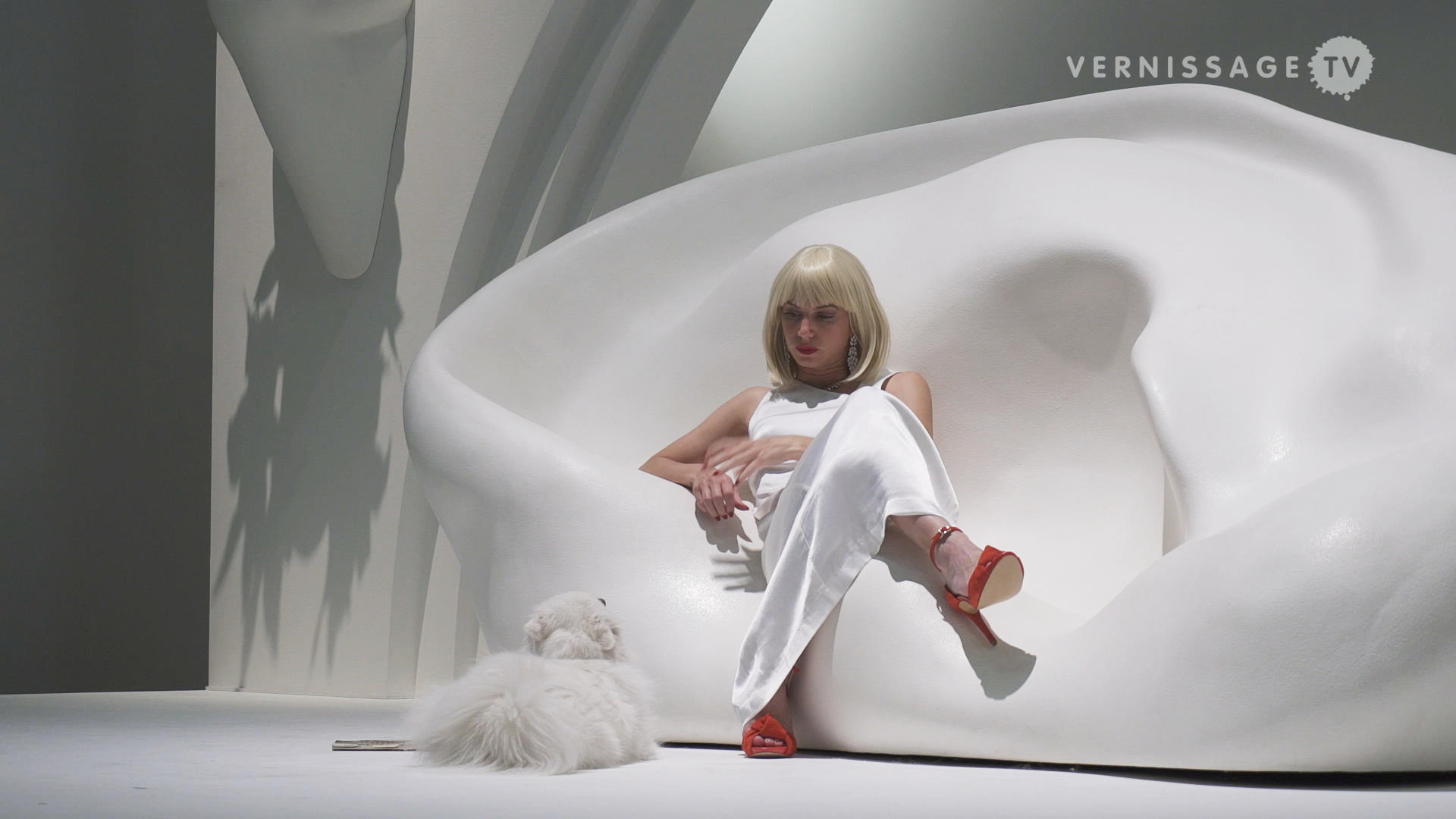
Continuing with his longstanding interest in models, digital puppetry, and simulated set compositions, the artist will install large-scale 3D-printed sculptures of hands, feet, heads, and limbs around the space, echoing the bodies of the digital performers on screen. As viewers watch the videos, they will be surrounded by these giant body fragments, which will also serve as seats to rest on. This creates a dramatic scene of deconstruction derived from computer-generated imagery that blurs the boundary between “reality” and “digital” space.
Li Yi-Fan comments, “My practice has always been rooted in the personal emotions, but in this project, I ask how these intimate thoughts resonate collectively with others from my generation. I hope viewers of Screen Melancholy embrace both a solitude journey and also join a shared venture to the world we all live in right now, reshaped by technology and dictated by algorithms. Image was once so important. It connects us with the world like a window. But now that we realize this window is nothing but a flat surface, how should we respond?”
“Using such tools as real-time engines and modeling systems, Yi-Fan deconstructs the structure of image-production technology,” Raphael Fonseca observes. “When this intersects with the dark humor he often employs in his works, he sheds light on a certain melancholia that connects all viewers in front of a flat screen. As the first quarter of the twenty-first century draws to a close, rather than offering magical solutions or moralizing responses to the post-fictions and digital narcissisms that grow ever more constricted, Yi-Fan suggests that each of us contains something of the prisoner, the puppeteer and the puppet. He allows us to accept the melancholia of this condition and get ready to embrace an existence as flattened as a screen. And this is only the beginning.”
On the afternoon of the opening day, a public talk will be held between Li and Fonseca, in which they will share the creative process behind the exhibition. Afterward, the South Korean artist Eunju Hong will present She seemed devastated, when I was weeping with joy, a dance exploration of melancholy and bodily movement. Alongside the opening, TFAM will also release a new bilingual Artist Book documenting Li’s artistic career. Following a dialogue between Fonseca and Li, the book walks through 13 keywords such as ‘windows,’ ‘machinima,’ ‘physical body’ and ‘controller’ that connect the artist’s important previous works. The book will be available for purchase at the Taipei Fine Arts Museum Bookstore in May.
About the Artist, Li Yi-Fan
Li Yi-Fan (b. 1989) lives and works in Taipei, Taiwan. He often explores the relationship between people and technology in the digital age with a unique sense of black humor. He excels at using self-developed game engines and, working as a one-person crew, im-provisationally acting out the narratives that lie in the background behind image pro-duction. In recent years, with the support of such projects as the National Culture and Arts Foundation’s “WSAD” and Taiwan Contemporary Culture Lab’s “Toolkit of Mad-ness,” Li has conducted studies on machinima and developed a series of game-engine-based image production toolkits to create artworks such as important_message_360. mp4, rewiring, howdoyouturnthison, and What Is Your Favorite Primitive. He has also been featured in the 2020 Taiwan Biennial “Subzoology,” the 2020 Digital Art Festival Taipei “01_LOVE,” the 2021 Asian Art Biennial “Phantasmapolis,” and the 2023 Taipei Biennial “Small World.”
His work was also featured in the 2024 Art Spectrum exhibition “Dream Screen” at the Leeum Museum of Art in Seoul. In 2024, he received the Hong Foundation’s NTD 1 million (USD 31,000) 8th Tung Chung Prize for a newly commissioned work. With support from the Hong Foundation, Li is a resident at the Rijksakademie van Beeldende Kunsten program in Amsterdam for 2024–25.
Previously, What Is Your Favorite Primitive garnered him the 46th Golden Harvest Award in 2024 at the Taipei Golden Horse Film Festival. He won the Visual Arts Award at the 2022 Taishin Arts Award for his earlier work howdoyouturnthison (2021), which explored virtual reality and image-making tools.
About the Curator, Raphael Fonseca
Raphael Fonseca, born in Rio de Janeiro, Brazil, lives in Denver, United States. He is curator and head of Modern and Contemporary Latin American Art at the Denver Art Museum, where he has worked since 2021. Currently, he is one of the curators for Counterpublic 2026, a Triennial opening next September in St. Louis, United States. He is also co-curating the 13th edition of Sequences, a visual arts biennial in Reykjavik, Iceland, in 2027. He was the chief curator of the 14th Mercosul Biennial in 2025. From 2023 to 2025, ArtReview magazine listed him among the 100 most influential people in the global visual arts.
Notable projects include “Fullgás: Visual Arts and the 1980s in Brazil” (Centro Cultural Ban-co do Brasil, 2024-2025); “Sandra Vásquez de La Horra: The Awake Volcanoes” (Denver Art Museum, 2024); “Memory is an editing station”, 22a Biennale SESC_Videobrasil (SESC 24 maggio, San Paolo, 2023)“; “Sweat” (Haus der Kunst, Munich, 2021); and “Lost and Found” (ICA Singapore, 2019).
Taipei Fine Arts Museum
Founded in 1983, Taipei Fine Arts Museum (TFAM) is the very first museum of modern and contemporary art in Taiwan. Venturing into its 43rd year, TFAM has dedicated itself to the development of local artists in Taiwan while staying abreast of ongoing trends in international art scenes. It has pioneered the biennial trends for the region and overseen the operations of the Taipei Biennial since 1998, and the participation as Collateral Event at the International Art Exhibition – La Biennale di Venezia since 1995, coloring its visions with stronger overtones of global strategy.