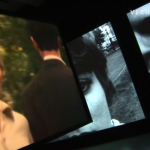
Paul Chan’s “Happiness (Finally) After 35,000 Years of Civilization (after Henry Darger and Charles Fourier)” (2000–2003) is the artist’s breakthrough early work, a looping 17-minute digital animation (often listed as 17:20) created using Flash techniques reminiscent of early web banner ads. It was made during his MFA at Bard College and draws heavily on the surreal, violent, and erotic imagery of Chicago outsider artist Henry Darger, particularly the young “Vivian Girls” from his epic The Story of the Vivian Girls.
The animation cycles between two contrasting states on an ultra-widescreen format, often projected onto a distinctive sparkle vellum screen resembling a torn scroll. In idyllic sections, colorful figures frolic in lush landscapes, indulging freely in eating, sleeping, and open sexual pleasure — inspired by the radical utopian visions of 19th-century French socialist Charles Fourier, who imagined harmonious communities driven by liberated passions. These hedonistic, sensuous scenes are repeatedly interrupted by shadowy forces of war, greed, destruction, and chaos, leading to violent battle sequences and melancholic aftermaths.
The work explores the fragility of utopian dreams, the cyclical nature of hope and despair, and humanity’s persistent failure to realize ideal societies. Created in the shadow of the U.S. invasion of Iraq and post-9/11 anxieties, it blends outsider art, political critique, philosophy, and digital aesthetics to portray utopia as a recurring rhythm of building and collapsing ideals.
In the 2026 Julia Stoschek Foundation exhibition “What a Wonderful World: An Audiovisual Poem” at the historic Variety Arts Theater in downtown Los Angeles (on view February 6–March 20), the piece was presented as a single-channel rear-projection installation. It was deliberately paired with Georges Méliès’s A Trip to the Moon (1902), highlighting recurring human fantasies of escape, technological progress, and other worlds while questioning why we fail to create a “wonderful world” on Earth — a theme resonant with contemporary discussions about space colonization versus planetary care.
What a Wonderful World: An Audiovisual Poem” at the Variety Arts Theater in Los Angeles. February 18, 2026.
–– Right-click (Mac: ctrl-click) this link to download Quicktime video file.