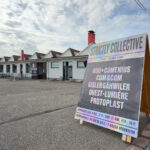
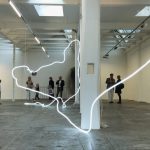
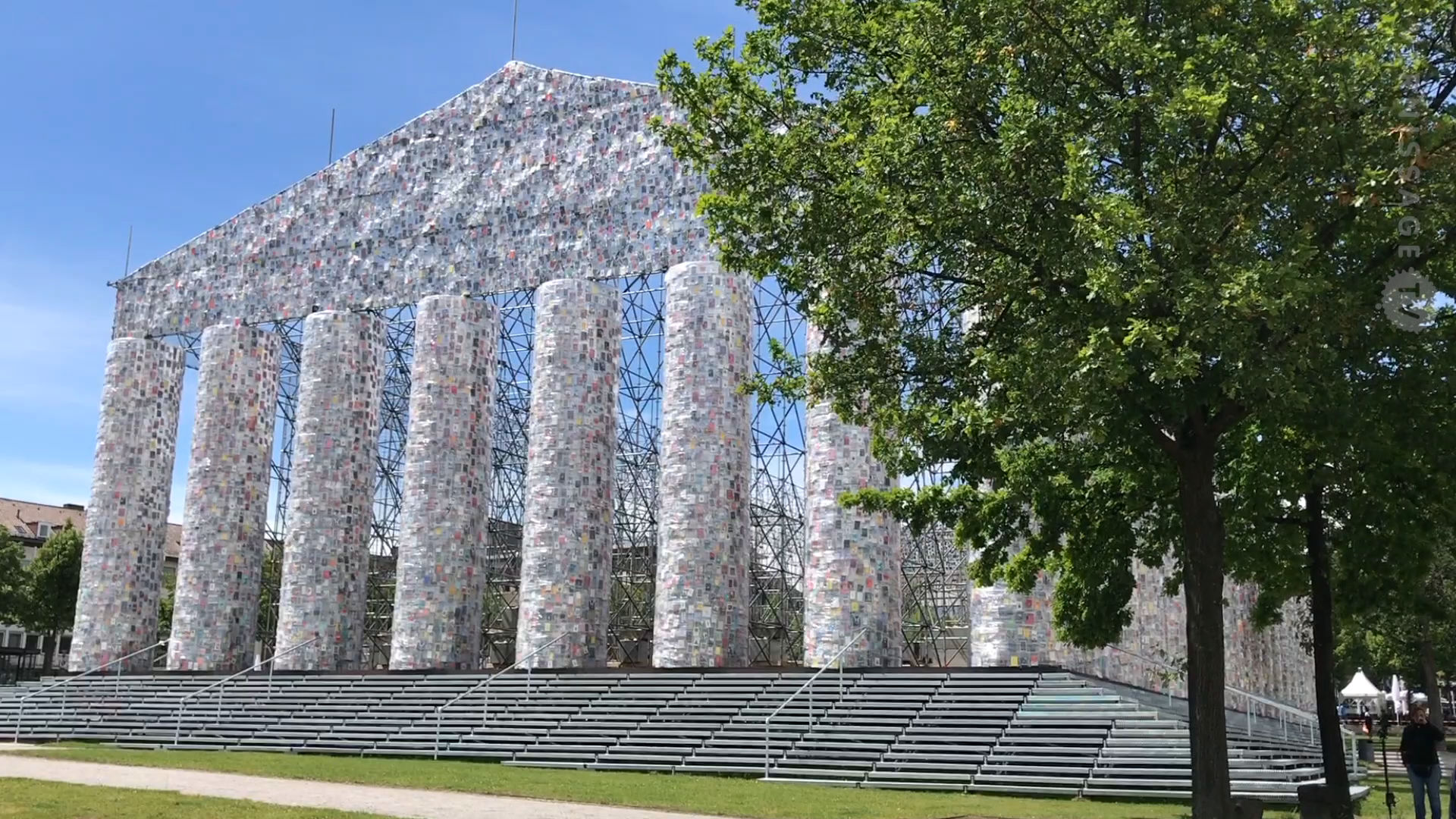
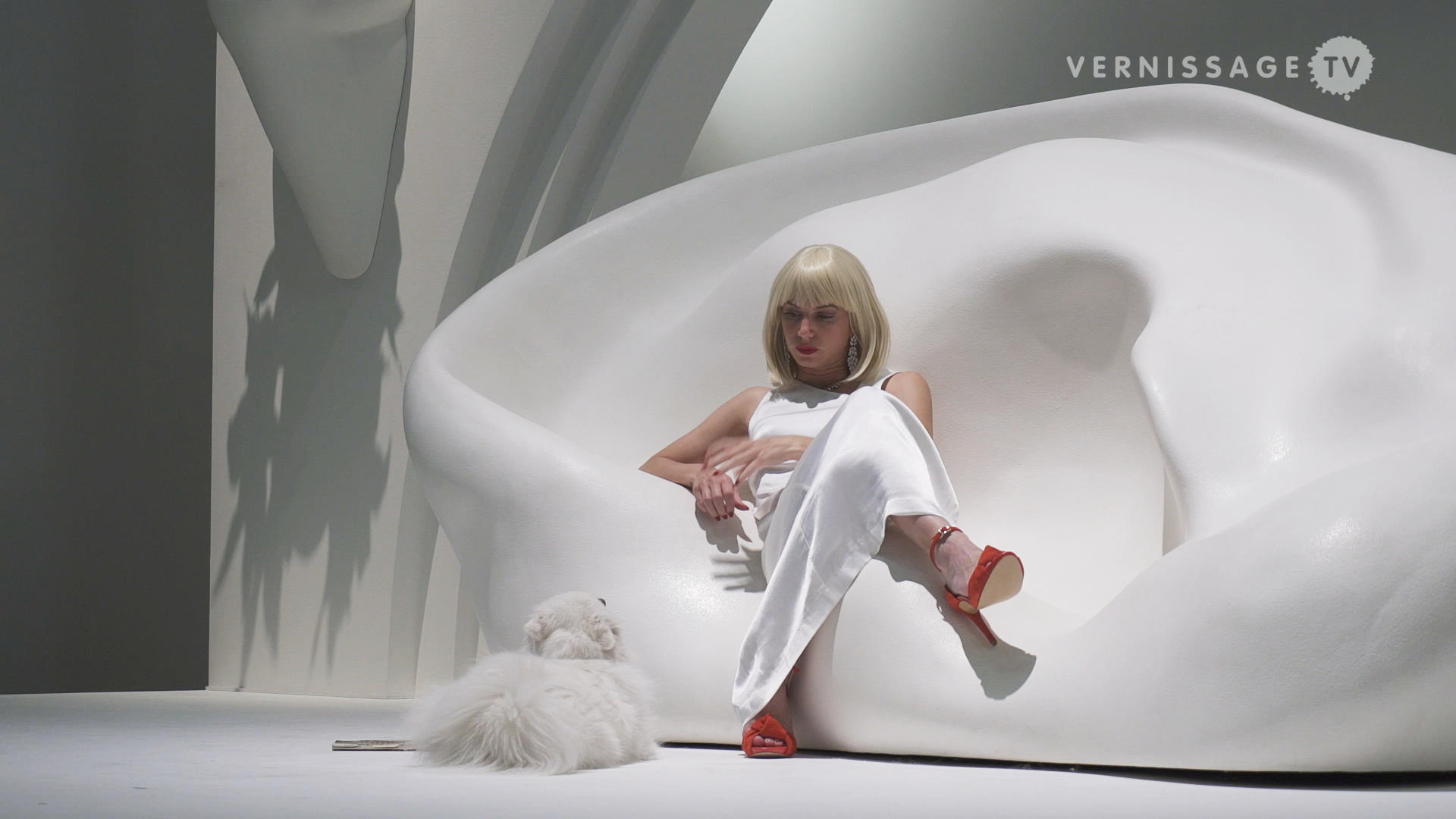
This video documents an art performance by the art collective Ouest-Lumière, held during the opening of the group exhibition “Strictly Collective” at the FABRIKculture art space in Hégenheim (France), near Basel (Switzerland). In doing so, Ouest-Lumière involves the art collectives Com&Com, Protoplast, Gisler Gähwiler, and Ado + Comenius.
Performance by Ouest-Lumière at FABRIKculture, Hégenheim (France). October 4, 2026.
Ouest-Lumière is an artist-run company that reactivates a defunct electrical utility as a machine for producing and circulating artistic energy, memory, and institutional parody. Ouest-Lumière is less a conventional artists’ collective than a long-running fictional enterprise created and directed by the French artist and researcher Yann Toma. He has called himself its “président à vie” (president for life) since 1991.
The historical company
The original Ouest-Lumière was a real electricity producer and distributor for the western suburbs of Paris. Its main plant stood on the Seine quays at Puteaux and was built around 1900. It was one of the largest suppliers of power in the west of the capital. In 1946, French electricity was nationalized under Électricité de France (EDF), and the company was absorbed. The Puteaux plant was later demolished, mainly between 1992 and 1995.
How the art project began
In the early 1990s, while the factory was being cleared, Toma occupied the site, almost clandestinely at first, and salvaged archives, bearer shares, electrical objects, and traces of the workers. In a room sealed since about 1920 he found old share certificates. He registered the name and trademark Ouest-Lumière with the French industrial-property office (INPI), formed an association, and declared himself lifelong president.
From that point the company no longer produces electricity. Its stated object is the production, distribution, and exploitation of “énergie artistique” (artistic energy) in every form, especially in the west of Paris and abroad. The old corporate statutes are rewritten almost word for word, with “artistic energy” substituted for electrical power.
How it works
Ouest-Lumière operates as a bureaucratic, network-shaped fiction that is also a real legal entity:
- A network of shareholders and “agents,” at times described as more than 200 people worldwide, who take on invented roles (directions, embassies, quality control, and so on).
- Ceremonies, share certificates, medals (for example the “Ordre du Grand Tesla”), press releases, and internal documents that mimic corporate life.
- Reuse of abandoned electrical sites and urban furniture, and the archiving of industrial memory—portraits of anonymous workers, collections of electrical objects (one exhibition at the Electropolis museum in Mulhouse in 2008 assembled more than 12,000 items).
- Installations, photographs, and performances under the Ouest-Lumière label. Early series include Ouvriers (1994) and Crimes sur commande (staged “crimes” commissioned by collectors and documented as if by a forensic office stamped Ouest-Lumière). Later public works include Dynamo-Fukushima at the Grand Palais in 2011, which drew more than 17,000 visitors in two days.
The project is collaborative in the sense that participants are given lasting roles and responsibilities, but it is tightly centered on Toma’s persona as president. Critics such as Stephen Wright and Paul Ardenne have described it as a “heuristic fiction”: an absurd, neo-liberal-looking company that mirrors the spread of immaterial labor, of which the artist is a prototype. A book of interviews with Toma is titled Faut-il abolir Ouest-Lumière? (“Should Ouest-Lumière be abolished?”).
Place in his career
Toma (born 1969 in Paris) studied with the body-art pioneer Michel Journiac and is a professor at Université Paris 1 Panthéon-Sorbonne. Since 2009 he has also sat at the United Nations as an artist-observer. Works made under the Ouest-Lumière name are in collections including the Centre Pompidou and the Fonds national d’art contemporain, and have been shown at venues such as Espace EDF Electra, the Maison Rouge, Culturgest in Lisbon, and the Saatchi Gallery.