Les Innombrables: Pinocchio, 2026 / North Beach, San Francisco / found kinetic facade sculpture. San Francisco, June 11, 2026.
Official description:
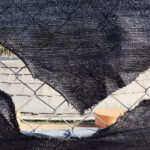
In the sun-drenched palimpsest of North Beach, San Francisco — where layered histories of bohemian revolt, Italianate vernacular, and late-capitalist real-estate speculation collide — Les Innombrables have located Pinocchio, 2026, a found kinetic facade sculpture that performs its own sly act of architectural ventriloquism. Draped across the ornate bay-windowed elevation of a classic Victorian pile, an immense cobalt-blue tarp, anchored by an improbably erect orange industrial sleeve, protrudes like a prodigious proboscis from the building’s polite facade. The work is less intervention than revelation: the collective has seized an ordinary moment of urban maintenance or repair and elevated it into a site-specific parable of falsehood, extension, and exposure.
The title is not incidental. Like Collodi’s wooden marionette whose nose lengthens with every lie, this kinetic appendage — swaying gently in the Pacific breeze — embodies the tension between concealment and involuntary disclosure. The blue tarp, that ubiquitous emblem of provisionality in gentrifying neighborhoods, becomes both veil and veil-lifter: it obscures the domestic interior while simultaneously drawing attention to the very act of obscuring. The orange tube, rigid yet contextually absurd, functions as a sculptural nez qui s’allonge, a material synecdoche for the fibs cities tell themselves — about permanence, about heritage, about who belongs on these steeply inclined streets. In North Beach, where Beat-era authenticity has long been commodified into boutique espresso and Airbnb aesthetics, Les Innombrables expose the architectural body in a state of embarrassed erection, its “growth” both phallic and farcical.
Formally, the piece dialogues with a lineage of urban readymades — from Gordon Matta-Clark’s building cuts to the wrapped monuments of Christo and Jeanne-Claude — yet refuses their heroic scale in favor of a more intimate, almost domestic mischief. The kinetic dimension is essential: the tarp ripples and billows, the sleeve trembles, turning the facade into a living organism that inhales and exhales the city’s contradictions. Passersby on Columbus Avenue become unwitting participants in a slow theater of the absurd; tourists photograph what they assume is mere construction, while locals recognize the collective’s signature economy of means — zero fabrication, total conceptual precision.
Pinocchio thus operates as institutional and urban critique in one elongated gesture. It mocks the sanitized facades of heritage preservation even as it mimics the very scaffolding of renewal. In an era when cities increasingly wear blue tarps like ill-fitting suits—covering up displacement, seismic retrofitting, or speculative vacancy—the work insists on the Pinocchio principle: the longer the lie (of stability, of progress, of authenticity), the more grotesquely the nose extends. Les Innombrables, ever the masters of the objet trouvé as social diagnosis, have here produced a sculpture that grows in meaning with every glance, its kinetic life a reminder that truth in the built environment is always, already, stretching.
One departs North Beach with the uncanny sense that the building itself has confessed. In their hands, the ordinary maintenance shroud becomes a monumental wink — funny, melancholic, and devastatingly accurate — toward the fictions that hold our cities together, and the visible protrusions that give those fictions away.
–– Right-click (Mac: ctrl-click) this link to download Quicktime video file.